

Our product portfolio includes the Langmuir-Blodgett Film Deposition system, a wide variety of Dip Coating and Spin Coating systems, an Ultra-Violet Curer system, and finally a brand new Contact Angle Meter system.

Spin Coating Systems are widely used to create uniform Thin Films of various materials, often polymers, onto the surface of a substrate by employing the concept of centrifugal force.

Dip Coating Systems are very useful instruments for Fabricating & Characterizing Self-assembled Structures. Formation of Multi-layer Thin Films is also possible with Apex Dip Coating Systems.

Langmuir-Blodgett (LB) Film Deposition Systems are very useful instruments for Fabricating & Characterizing Single or Multi-layered Thin Films of Mono-molecular Thickness.

Contact Angle Meter system is useful for evaluating the cleanness of solid surfaces as it is sensitive enough to show different results even with a small amount of contamination such as mono-layer orders.

Ultra Violet (UV) Curing is a speed curing process in which high intensity ultraviolet light is used to create a photochemical reaction that instantly cures inks, adhesives and coatings.
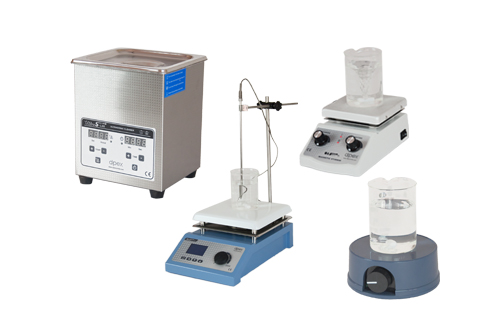
Laboratories used for scientific research take many forms because of the differing requirements of specialists in the various fields of science and engineering.
Research Application
Molecular Structure Studies
Self-assembly
Layer by Layer Molecular Assembly
Polymer Research
Technology Information
Spin-Coating Technology
In present-day thin film studies, Spin Coating Systems are an indispensable tool for fabricating thin films on a suitable substrate. The Spin Coating Technique has an immense role in the field of lithography and many other fields associated with Thin Film Fabrication & Characterization.
Contact Angle Measurement Technology
Solid materials like metals and glasses generally have large surface free energy (the Υs should be large) and water droplets on those materials should form a small contact angle. On the other hand, when the solid surface is contaminated with organic materials, water droplet will form a larger contact angle. The Contact Angle is sensitive enough to show different results even with a small amount of contamination such as mono-layer orders.
Dip-Coating Technology
Dip Coating is the process of immersing a substrate into a tank containing coating material, removing the piece from the tank, and allowing it to drain. The coated piece can then be dried by force-drying or baking. It is a popular way of creating thin film coated materials along with the spin coating procedure.
Langmuir-Blodgett Technology
A Langmuir-Blodgett (LB) film is a monolayer of organic materials, deposited from the surface of a liquid onto a solid by immersing the solid substrate into the liquid. The monolayers are assembled vertically and are composed of amphiphilic molecules with a hydrophilic tail and a hydrophobic tail.